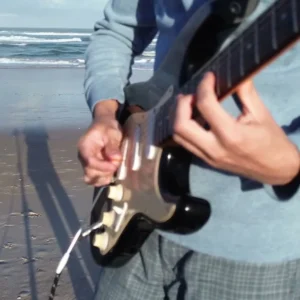
Reimagining a cinematic classic like Clint Eastwood with just my guitar and a loop station was an exciting challenge. The Gorillaz’ iconic track has stood the test of time, its raw energy and rugged charm evoking memories of ’70s rock and Western movies. By stripping it back to its core, I aimed to uncover the essence of this genre-bending song and give it a fresh, stripped-down spin.
The Engineering Behind the Art
To take your live looping setup to the next level, think like a Full Band Sound engineer. Start with a strong rhythmic foundation on your guitar – a solid chunky pocket that sets the tone for your arrangement. Then, add layers of sound: body percussion, bass, harmony, and lead. My latest track, Clint Eastwood Guitar Loop, is a perfect example of this approach in action.
By stacking these sounds together in real-time, you can create a glassy, polished sound that’s eerily reminiscent of the Gorillaz – those iconic guitar riffs are always a crowd-pleaser! With every loop, your arrangement grows and evolves, like a modular puzzle coming together to form a cohesive whole. The key is to find that sweet headroom where every instrument sits comfortably alongside the others. When done right, live looping becomes an art form that’s greater than the sum of its parts – no backing tracks or AI needed!
Music as Iterative Design
Think of music as a high-stakes game of iterative design. Each loop is like a well-designed module – it starts with a solid foundation (rhythmic percussion on my guitar), then adds depth with bass and harmony layers, and finally, unleashes the lead solo. Just like in engineering, every iteration builds upon the last, refining the sound until it’s just right.
When I’m building a song using loops, it’s all about experimentation – trying out new sounds, layering them up, and seeing what sticks. I remember working on my Clint Eastwood Guitar Loop, where I layered a haunting melody with crunchy percussive elements to create this glassy, pocket-perfect sound. With each iteration, the arrangement grows from a single rhythmic cell into a full-fledged band sound.
The beauty of live looping lies in its modular nature – every instrument is emulated from my guitar and loop station, making it feel like an extension of myself on stage. It’s this self-sustaining system that allows me to create complex arrangements without the need for backing tracks or AI assistance. With each iteration, I’m refining the design, pushing the boundaries of what’s possible with just one instrument and a loop station.
Why Constraints Make Better Music
Constraints can be a game-changer when it comes to live looping. I mean, take Clint Eastwood’s Guitar Loop – that guy’s got some serious chops, and he nailed it with just my guitar and my trusty loop station. The key is embracing the limitations instead of fighting them. By stripping away excess, you’re left with a more focused sound that’s all about the music. That’s where the real magic happens.
The one-guitar philosophy is all about finding that sweet spot between chunky rhythms and pocket-driven grooves. When you’ve got to rely on every note, every strum, and every pick, it forces you to be more precise – which means a more guitar-centric sound that’s just as effective without overdubbing or relying on glassy production tricks. In the end, that’s what makes live looping so satisfying: the freedom to create something real-time, with nothing but your instrument and a loop station to guide you.
Chasing the Melody: Improvising Over Clint Eastwood
To solo over a live build like my guitar loop setup when playing “Clint Eastwood”, you need to be totally absorbed in the music. The flow state is all about surrendering to the moment, letting go of any preconceptions or self-editing. It’s like riding a wave – you can’t control it, but you can feel its power. As I tap into that energy, my phrasing becomes more intuitive and spontaneous.
The beach environment plays a huge role in shaping my melodic choices. The sound of the waves and wind creates this unique sonic backdrop that feels both calming and energizing at the same time. When I’m playing over Clint Eastwood Guitar Loop, the golden hour light filtering through the palm trees casts long shadows on the sand, adding depth to every note I play. It’s like my music is being infused with a sense of place and atmosphere, making it feel more real and alive.
Letting beach Influence the Phrasing
When playing on a beach like that, I find myself drawn to lower tunings and more open chord shapes. The wind’s constant testing of my guitar’s tuning makes me appreciate the headroom – and when I’m having fun, that means less tension in every note. That’s what Clint Eastwood Guitar Loop does for me: it takes a laid-back, pocket feel and gives it a glassy sheen. It’s all about finding that sweet spot where the rhythm section comes together, like a Gorillaz guitar riff, and the rest is just a fun ride. The slower tempo of sunset makes every phrase feel more honest, and I love how that playful energy translates to my playing.
Choosing the Right Scale for the Mood
Scale choice can make or break a mood. In live looping, it’s all about creating an emotional tone that complements the music. Think of Clint Eastwood Guitar Loop – his low-frequency, blues-driven riffs evoke a sense of grit and tension. That’s because blues scales have a natural, expressive quality to them.
For funk-inspired arrangements, you might opt for a rhythm guitar with high frequency strumming and percussive muting, creating a bright, energetic sound that cuts through the mix. Country lead guitars tend towards clarity and precision, using high frequencies to sit above the bass layer.
When it comes to emotional tone in improvisation, scale choice is key. Blues scales are great for evoking feelings of raw emotion, while funk-inspired scales can create a sense of energy and urgency. By choosing the right scale for the mood, you’ll be able to craft riffs that transport your listener to another world.
The same goes for lead guitar – using rock or surf-inspired scales can add depth and complexity to your sound, while country-style leads will give you a more articulate, precise feel. The key is to experiment with different scales and find what works best for the mood you’re trying to create.
**Looping For The Summer Presents: Clint Eastwood Guitar Loop**
I was stoked to get a chance to channel my inner Spaghetti Western hero and recreate one of Gorillaz’ most iconic guitar riffs – “Clint Eastwood” – using live looping. I started by laying down a chunky rhythmic foundation on my guitar, followed by a snappy pocket bass line that cut through the mix like a hot knife through butter. As I began to add more layers, the headroom in the soundstage opened up, and I was able to create a glassy, shimmering atmosphere that perfectly captured the mood of Damon Albarn’s songwriting.
Want to hear where the loop goes when there is no plan? Every improvisation session is a different conversation between the guitar and the environment — explore more live loop improvisations and see what comes out.