
You know how some songs just never get old? Take Five by The Dave Brubeck Quartet is one of those timeless jazz classics that continues to inspire and influence musicians across genres. Released in 1959, this iconic five-piece jazz improv piece has been a benchmark for live looping guitar performances, like this one. I’m excited to take you on an improvisational journey through the familiar yet fascinating world of Take Five.
Listening is the First Instrument
Active listening is the most fundamental musical skill. When you’re stuck on a tricky Five Piece Jazz Improv riff, your trained ear isn’t just picking out individual notes – it’s recognizing patterns and relationships that help you improvise like a pro. By tuning in to the way a melody flows, you can start to make sense of the music before you even play it.
I remember working on my Take Five Guitar Loop and how the drummer’s “walking” pattern really helped me establish the rhythmic foundation. With practice, your ear becomes so attuned that memorization starts to feel like overthinking – you’re too busy trusting what you hear to worry about individual fingerings or chord progressions.
The connection between hearing music and playing it is all about developing this active listening skill. When you can pick out the inner workings of a song, you start to understand its underlying structure – which makes it way easier to loop and play like a full band on your own.
Hearing the Note Before You Play It
When I’m setting up to play Take Five Guitar Loop on my loop station, I always start by tuning into that internal rhythm section. The key is to hear the note before you play it – that fleeting sense of anticipation when your mind and fingers are in sync. Think of it as a mental ‘click’ that allows you to react instead of just reacting.
For me, this inner hearing skill separates intentional playing from mindless noodling. By training my ear to anticipate the beat, I can start building layers on top – percussion, bass, harmony, and lead all coming together in real-time. It’s a powerful tool for creating that five-piece jazz improv feel without needing an entire band.
The beauty of live looping is that it lets you engineer your own sound, using every ounce of logic to get the perfect take. I’ve found that with practice, this inner hearing becomes second nature – and it opens up a whole new world of possibilities on my guitar.
The Repetition Sweet Spot
Repeatedly listening to and playing the same chord changes trains my ear to recognize them in new contexts. It’s a weirdly liberating feeling when I’m on stage with my guitar and loop station, knowing that certain chord progressions are instantly familiar. To me, this sweet spot is all about finding that balance between repetition and exploration – enough time with a given progression to internalize it, but not so much that it becomes mechanical.
For instance, when working on Take Five Guitar Loop, I found myself stuck in a loop of the song’s iconic 5/4 rhythm. By listening to it repeatedly and playing along, my brain began to anticipate the next “tick” and allowed me to focus on adding texture and interest with added loops and overdubs. This transferable skill from practice helps me stay engaged when I’m watching others perform – whether it’s a seasoned pro or an aspiring musician trying out new ideas.
The Engineering Behind the Art
To take Five Guitar Loop to the next level, you’ve got to understand how the Full Band Sound works. We’re talkin’ about stackin’ sound with a rhythmic foundation on the strings – that’s where it starts. Then comes bass, harmony, and lead layers, all captured and repeated in real-time. It’s like buildin’ a modular arrangement from scratch, layer by layer.
My guitar is my trusty sidekick in this process, paired with my loop station to create an endless supply of instruments. Body percussion, bass, harmony, and lead – every sound comes from the same source. We’re not relyin’ on backing tracks or AI; everything’s built live, using engineering logic to bring it all together.
The key is findin’ that sweet spot where each layer complements the next, creatin’ a rich, chunky sound that’s full of pocket. It’s not just about loopin’ notes – it’s about craftin’ an arrangement that takes you on a journey. That’s what makes Take Five Guitar Loop so special: it’s five instruments in one, all comin’ together to create somethin’ truly unique.
Applying Engineering Logic to Music
Think of live looping like building a software application – you start with a solid foundation, then layer in features and functionality. In music, that means starting with a rhythmic backbone (percussion on the strings) before adding depth with bass, harmony, and lead layers. It’s not unlike writing code: you need to establish a clear framework before adding complexity. A well-structured loop is key – just like how a well-structured algorithm ensures your app runs smoothly. Take Five Guitar Loop is proof that with the right approach, one guitar and one loop station can create a professional Full Band sound in real-time, making it easy for anyone to achieve that five-piece jazz improv feel with just their instrument and a little creativity.
Why Constraints Make Better Music
Constraints can spark innovation like a fresh string on my guitar. When I’m given the challenge of playing Five Piece Jazz Improv with just one instrument and my loop station, I’m forced to think outside the pocket. The lack of space for additional instrumentation makes each note count, and that’s where the magic happens.
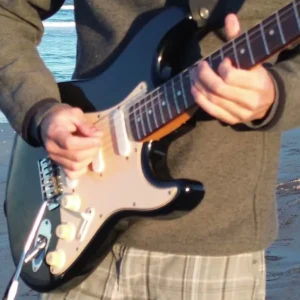
Think about it – when you’re looping Take Five on your guitar, every strum, pick, and slide is crucial. You can’t afford any mistakes or dead air. That pressure brings a level of focus and creativity to my playing that I never experience with more gear at my disposal. The result? A sound that’s both more intimate and explosive – like a burst of energy on the beach.
When you’re a Self-Taught Develooper, it’s not about having all the gear or a team to back you up – it’s about harnessing the power of your own imagination and creativity. And when constraints are applied, that’s exactly what happens: innovation blooms.
Take Five Guitar Loop Live Loop Five Piece Jazz Improv
When the rhythms of a jazz standard like “Five” come alive in my hands, something special happens. The rhythmic cell is born from the interplay between my guitar and the loop station, which becomes an extension of both instruments. I start with a simple pattern on the strings – a percussive foundation that echoes through every layer of sound. Then, I add depth with bass and harmony loops, followed by lead lines that dance around the arrangement. It’s a beautiful marriage of human intuition and technology.
Want to hear where the loop goes when there is no plan? Every improvisation session is a different conversation between the guitar and the environment — explore more live loop improvisations and see what comes out.
Explore other Advanced Live Loop Improvisation loops

Explore other loop covers of The Dave Brubeck Quartet
No videos available.